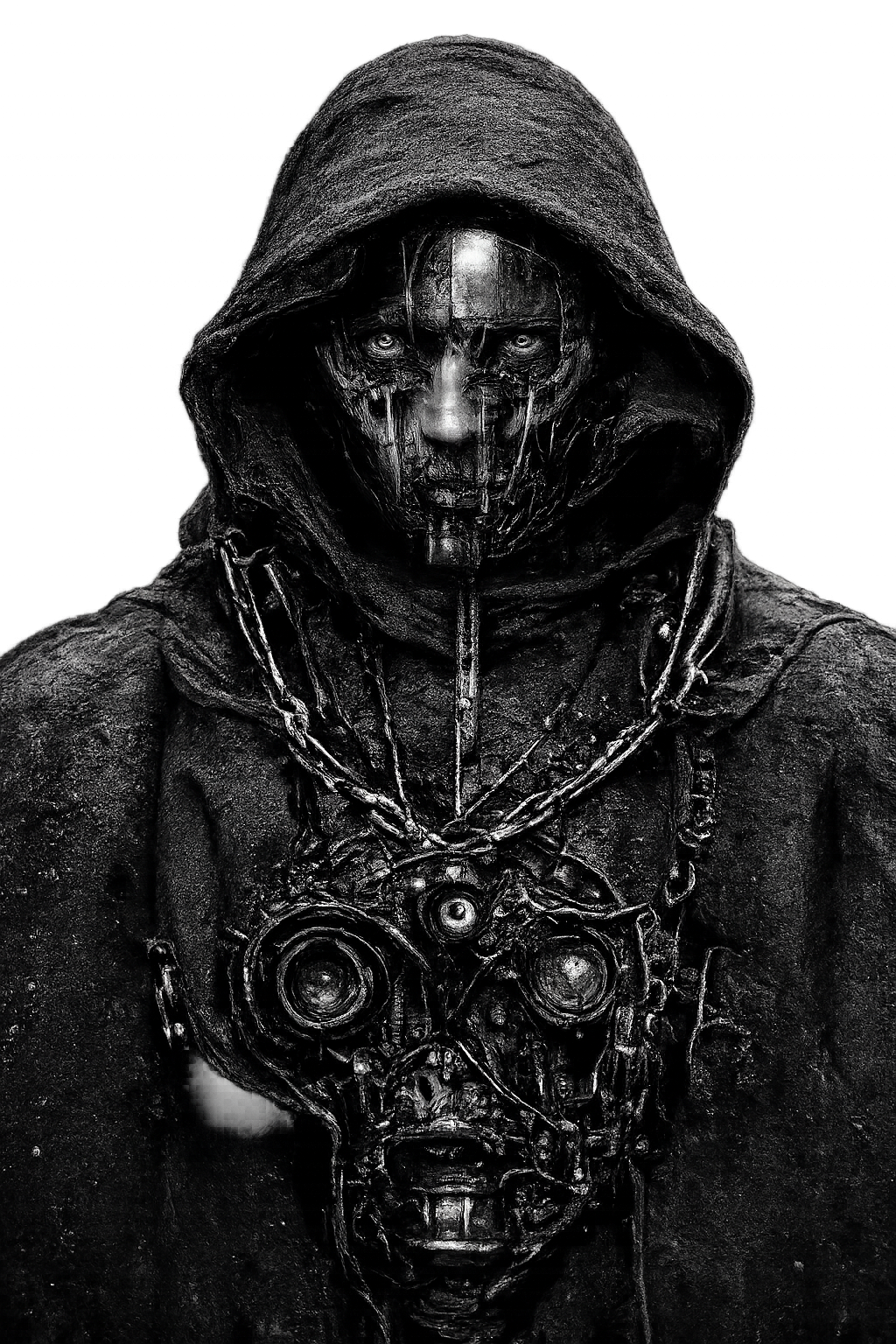
Animus - The Last Human: Chapter Two

Plans change.
You can say that calmly when it is somebody else’s work.
When it is your own, and months of thinking have already started shaping the air around a specific place, it hits you differently. Collaborative projects are fragile. Ideas have to stay flexible, and your grip on them looser than you’d like. Unless you are willing to scorch something for it.
I’m good friends with the director of the event. I know it’s nobody’s fault when something unravels at the last minute. She worked herself to the bone to get this show moving. She believed in the vision from day one.
When the call came to say the original location was gone, I could hear the damage in her voice.
It hurt her to say it.
It hurt me to listen.
The event in Millmount was shut down.
The version of the piece I had built in my head went with it.
That made anger difficult.
There was no one to argue with. No one to blame or try to persuade.
The decision was final.
It was cooked.
All I could do was take a deep breath, reset, and prepare to realise the version of the piece Louth Arts Council were comfortable with.
What emerged was not a replacement. It was a complete shift in tone.
In the shadow of Millmount, across the River Boyne, among the 13th-century remains of The Old Abbey and Hospital of St. Mary d’Urso, a different kind of space waited.
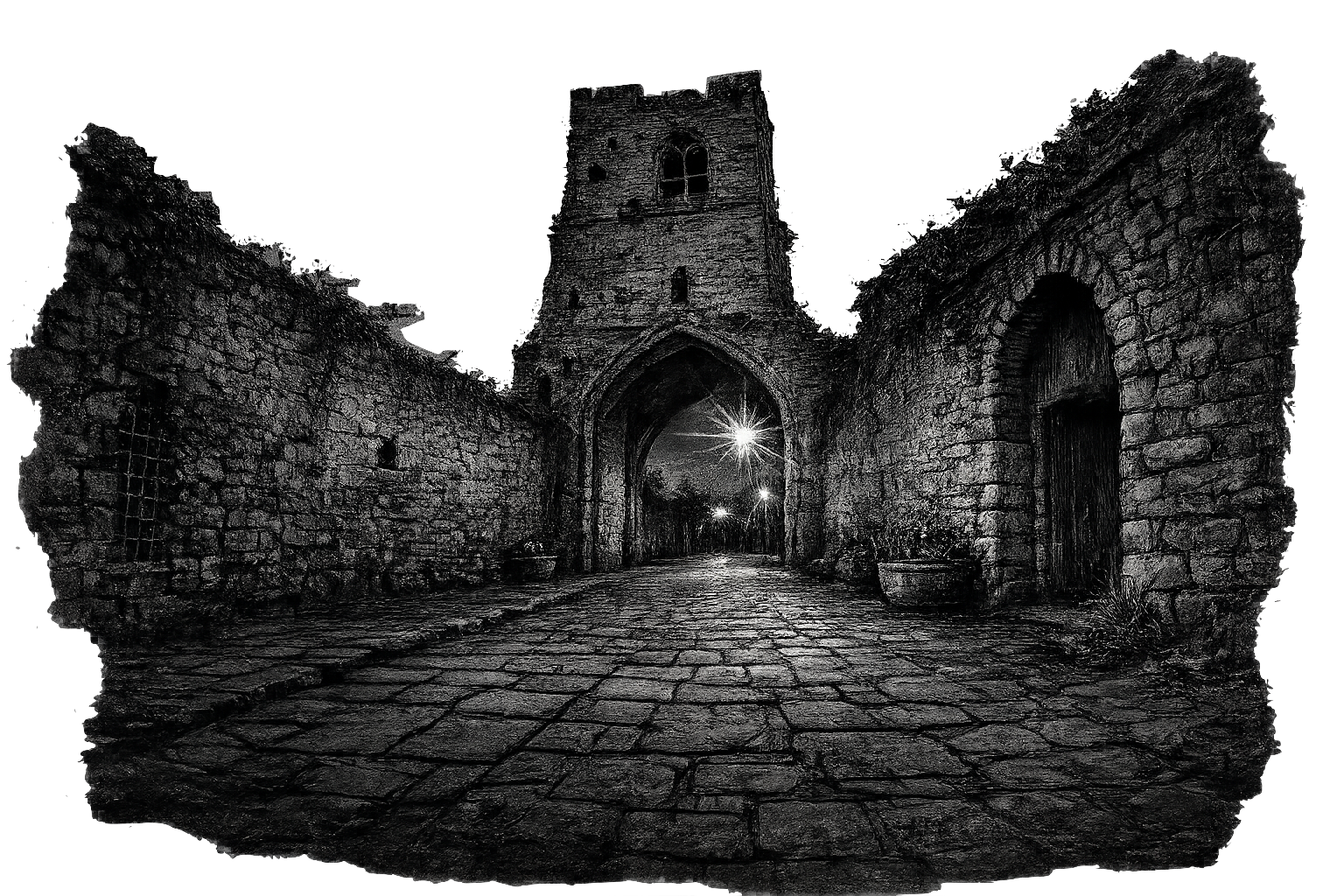
It didn’t have the openness of the courtyard. It felt compressed. Uneasy. As if something had happened there and never quite left.
A semi-forgotten stone laneway leads you toward it. Recently reopened after years sealed to the public, part preservation, part neglect, part nature reclaiming what work had abandoned. This had all been torn back to reveal the ancient relic in all its gothic severity. Industrial iron braces hold a crumbling gable wall in place beneath the weight of the looming belfry tower. The stone walkway was once the floor of the Abbey’s infirmary. The atmosphere feels like it carries the weight of the dying, the fevered, the prayed-over and the forgotten.
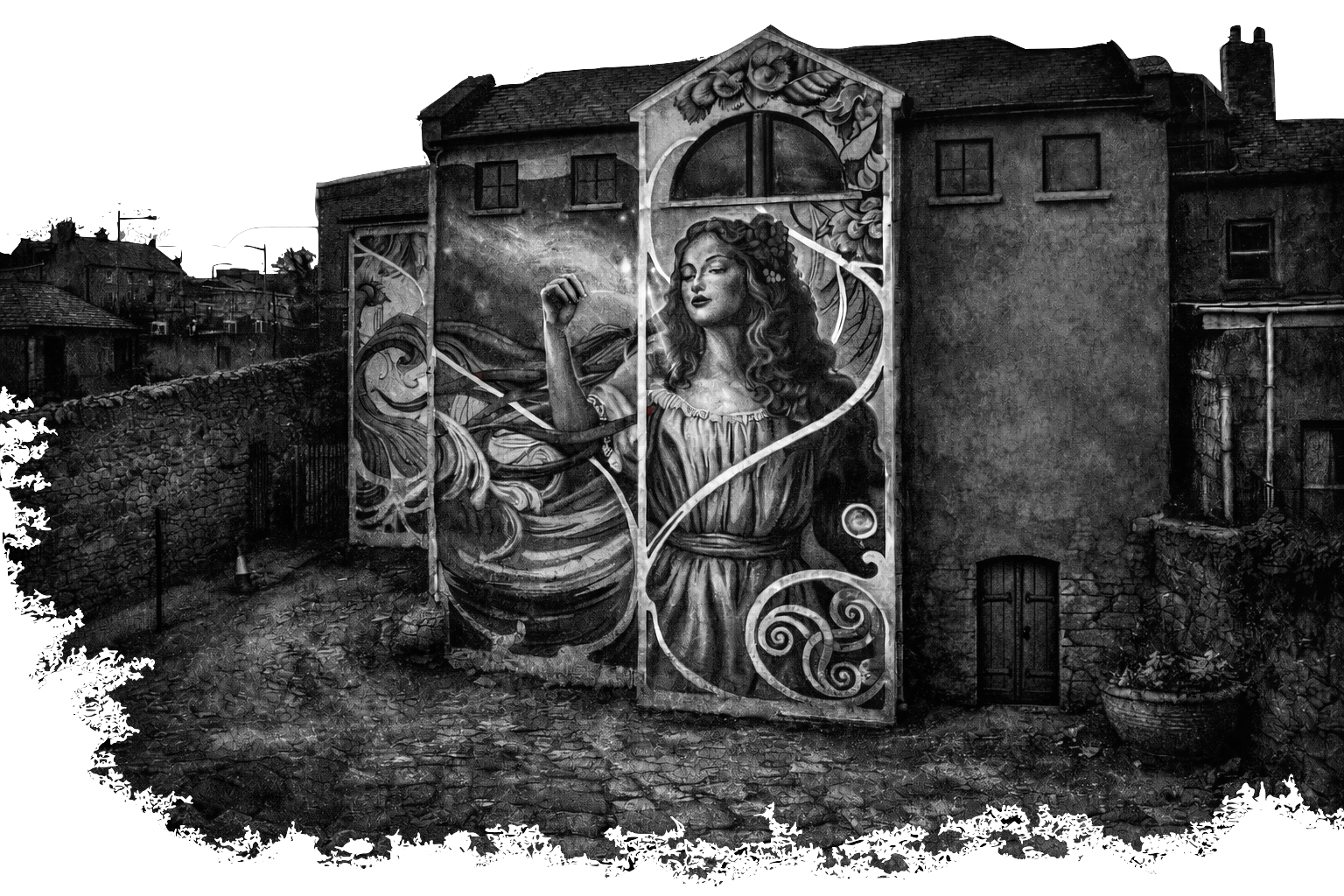
Passing beneath the medieval arches, the laneway opens into a small courtyard where a four-storey mural of Boann, The Goddess of the River Boyne, rises vertically along the wall. The river made human, watching the threshold.
But the installation would not live in that courtyard.
It would descend.
A narrow entrance, almost apologetic in scale, opens into a forgotten basement beneath the streets of Drogheda. Stone gives way to damp air. The sound of the town thins out. Light retracts. You step below the visible layer of the town and into something older, not curated or restored. Simply left.
Only after standing there, in that depth of silence, did the alignment stop feeling accidental.
Above ground, Boann remains fixed in motion. The river as origin, knowledge released, landscape shaped by encounter. In the deeper current of the narrative stands Amhairgin mac Míled, the one who arrived and spoke himself into the fabric of the island, naming wind, wave and earth as extensions of his own being.
River above.
Voice in memory.
And between them, underground, suspended in circuitry and projection, Animus – The Last Human.
The piece no longer felt displaced.
It felt positioned.
Not claiming land. Not shaping it. Not even naming it.
Instead, it occupied the seam between birth and legacy, between myth and infrastructure.
Asking what remains when both have already spoken, and when the next voice might not be human at all.